

How to Track AI Traffic in GA4 (ChatGPT, Gemini & Perplexity)
Track AI Assistant Traffic in GA4 for Better Insights

How to Track AI Traffic in GA4 (ChatGPT, Gemini & Perplexity)
Written by
Co-Founder & CEO

Track AI traffic in GA4 with new AI Assistant channels and insights to optimize SEO strategy, content performance, and digital marketing efforts.
AI platforms such as ChatGPT, Gemini, Claude, and Perplexity are becoming an important source of website traffic. Until recently, this traffic was often grouped under referral or direct traffic, making it difficult to measure its impact.
Google Analytics 4 (GA4) now includes an AI Assistant traffic channel, along with new Source Group and Source Platform updates that make AI traffic easier to identify and analyze. By understanding where AI-driven visitors come from, how they behave, and which content they engage with, businesses can refine their SEO strategy, improve content marketing services, and make smarter decisions across their overall digital marketing services in India.
This guide explains how to find AI traffic in GA4, understand Google's latest updates, and use these insights to improve long-term marketing performance.
What is AI Traffic in Google Analytics 4?
AI traffic refers to website visits that originate from generative AI platforms and conversational assistants.
These include platforms such as:
ChatGPT
Gemini
Claude
Perplexity
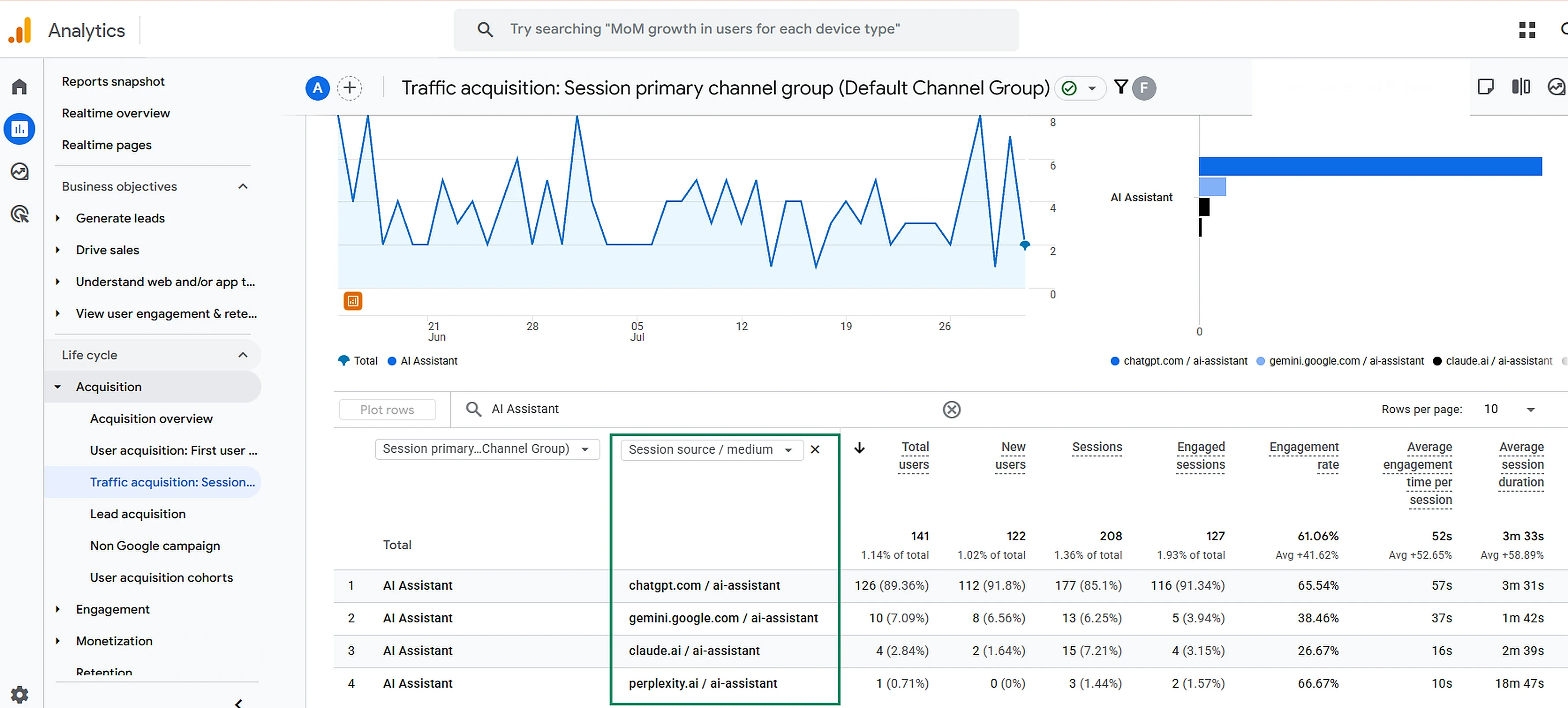
Instead of discovering content through a search engine results page, users receive recommendations directly from AI-generated responses and click through to the referenced website.
Previously, many of these visits appeared inside GA4 as generic referral traffic or other broad acquisition channels. This made it difficult to answer important questions such as:
Which AI platform sends the highest-quality visitors?
Which pages are being recommended most frequently?
Do AI visitors convert differently from organic visitors?
Is AI becoming an important acquisition channel for the business?
Google's recent updates now provide far greater visibility into these interactions.
For organizations investing in SEO services, measuring AI-driven discovery has become an increasingly valuable addition to traditional search reporting.
How to Track AI Traffic in GA4
With Google's latest updates, identifying AI-generated traffic is significantly easier than it was a few months ago. Instead of relying on complex custom reports or manually filtering referral sources, GA4 now automatically categorizes supported AI assistants while also giving marketers more flexibility through Source Groups and Source Platforms.
Here's how to start tracking AI traffic effectively.
1. Access the Traffic Acquisition Report
Inside GA4, navigate to:
Reports → Acquisition → Traffic Acquisition
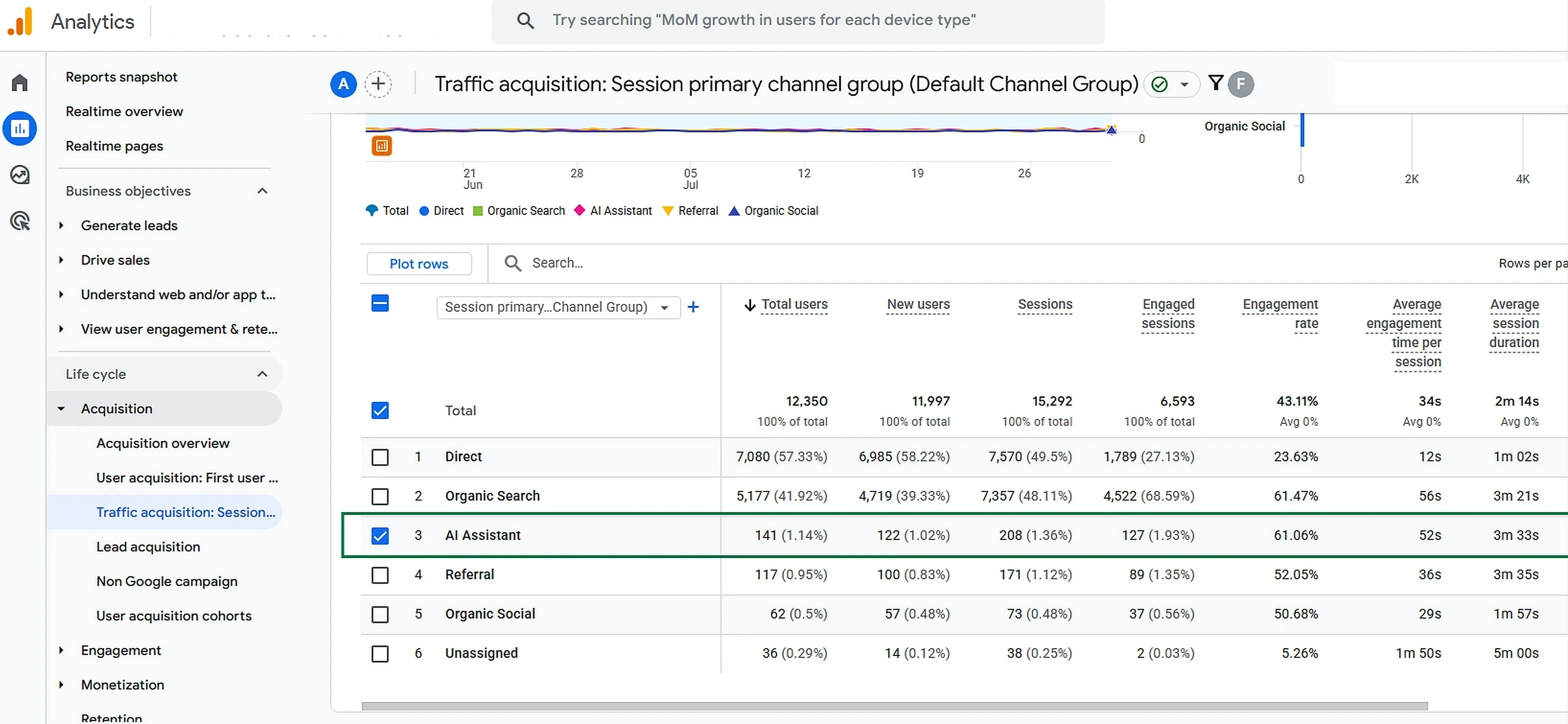
This report provides an overview of where your website sessions originate.
From here, switch the primary dimension to Session Source/Medium or Session Source. These dimensions reveal exactly where users are coming from rather than grouping them under broad acquisition channels.
If your website is already receiving visits from AI assistants, you may notice traffic from sources like ChatGPT, Gemini, Claude, or Perplexity appearing in your reports.
2. Use the New AI Assistant Channel
Following Google's May 2026 update, supported AI referrals are automatically classified using dedicated traffic dimensions.
Instead of appearing as generic referrals, qualifying visits receive:
Medium: ai-assistant
Channel Group: AI Assistant
Campaign: (ai-assistant)
This allows marketers to compare AI traffic directly against Organic Search, Paid Search, Referral, Email, Social, and other acquisition channels without creating custom rules.
For businesses already measuring the effectiveness of their SEO services, this additional visibility provides another important performance indicator that wasn't previously available.
3. Analyze Source Group and Source Platform
The June 2026 Source Group update improves reporting even further.
Rather than showing multiple inconsistent variations of the same source, GA4 now consolidates them into standardized reporting groups.
For example, instead of separately reporting:
FB
Meta-facebook
GA4 groups them under a single standardized Source Group.
The same approach now extends to emerging AI platforms like ChatGPT and Perplexity, creating cleaner reports, and making long-term performance analysis much easier.
Since Source Group is applied retroactively, marketers can also revisit historical data without rebuilding reports manually.
4. Compare AI Traffic Performance
Once AI traffic is visible, don't stop at measuring sessions.
Evaluate how these visitors behave compared to other acquisition channels by analyzing metrics such as:
Engagement rate
Average engagement time
Key events
Conversions
Landing pages
Revenue (for ecommerce websites)
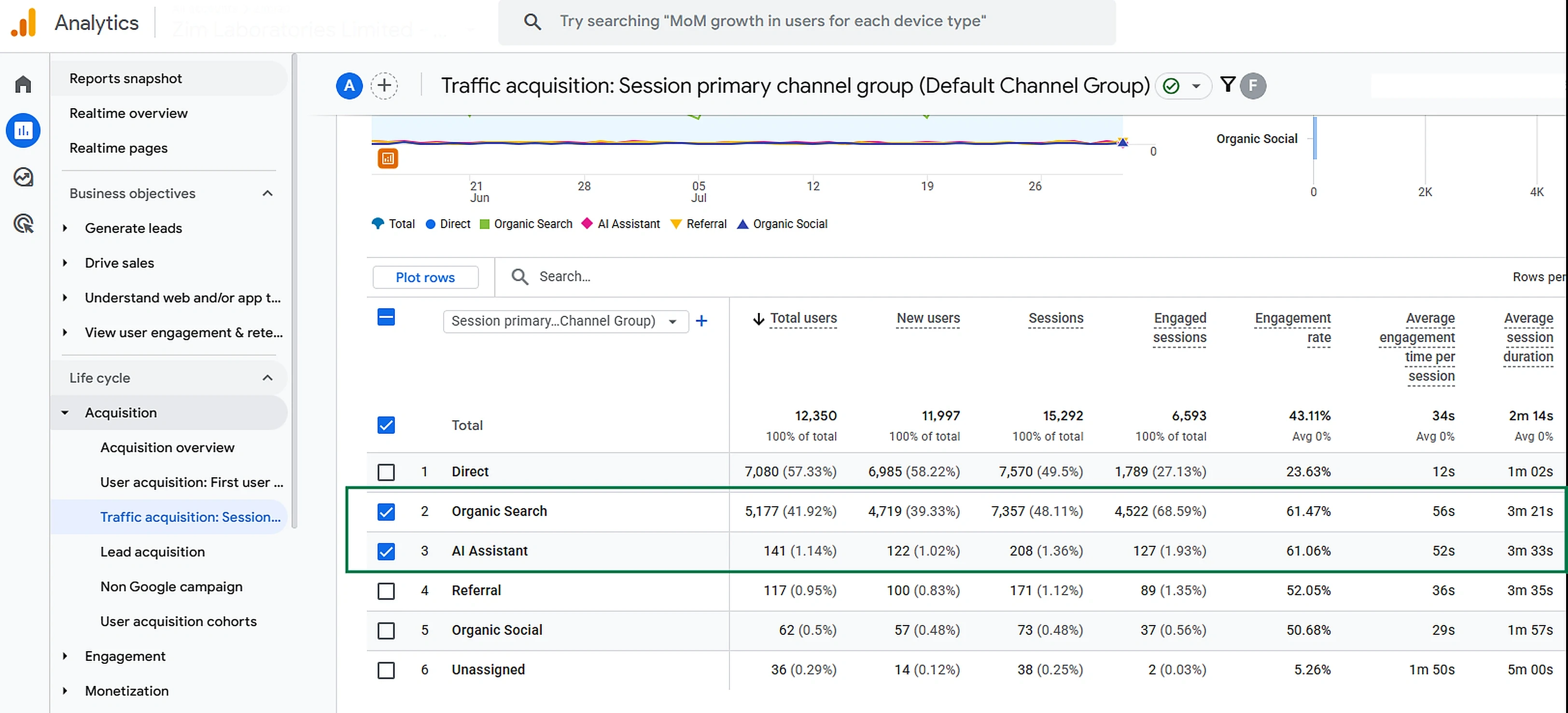
Many organizations are discovering that AI visitors often arrive with more specific intent because they have already interacted with an AI assistant before clicking through to the website.
Understanding these behavioral differences can help refine both your SEO strategy and your broader content planning efforts.
Understanding AI Traffic Dimensions
Google's new reporting dimensions make AI traffic considerably easier to analyze.
Medium
The new ai-assistant medium identifies traffic arriving from supported AI assistants.
Instead of being grouped alongside referrals, AI sessions now have their own dedicated medium, allowing marketers to isolate them with a single filter.
Default Channel Group
Traffic is automatically categorized under the AI Assistant channel.
This makes it possible to compare AI-driven discovery directly with Organic Search, Referral, Email, Social Media, Paid Search, and Direct traffic.
Because the channel is part of GA4's reporting structure, businesses no longer need to build custom channel groupings simply to identify AI referrals.
Campaign
Recognized AI visits are assigned the campaign value:
(ai-assistant)
This creates consistency across reports and allows marketing teams to filter AI traffic using campaign dimensions whenever required.
Combined with Source Group and Source Platform, these dimensions create a much cleaner reporting experience than previous GA4 implementations.
How ChatGPT, Gemini, and Perplexity Drive Website Traffic
Unlike traditional search engines that display pages of results, AI assistants provide direct answers generated from multiple sources before recommending relevant websites.
This creates a different user journey.
Someone researching a topic may first ask ChatGPT to explain a concept, request Gemini to compare products, or use Perplexity to summarize recent information. Only after receiving those responses do they decide to visit a recommended website.
These visitors often arrive with clearer intent because much of the discovery phase has already taken place inside the AI conversation.
Instead of focusing only on volume, an SEO strategy should examine engagement quality, conversion behavior, and the types of content AI assistants reference most frequently.
This information can influence future content marketing services, editorial planning, and even technical optimization efforts.
If you've already explored how AI is changing website visibility, our blog "AI Ate Your Traffic. Now What?" provides context.
How Digital Marketing Teams Can Use AI Traffic Insights
AI reporting should become part of broader performance reporting across SEO, paid media, content, and analytics.
Teams providing digital marketing services in India can use AI traffic insights to:
Identify high-performing content referenced by AI assistants
Discover emerging customer questions
Improve landing pages receiving AI visitors
Compare AI-assisted conversions with organic search conversions
Build reporting dashboards that include AI alongside traditional acquisition channels
Rather than replacing existing analytics practices, AI reporting adds another dimension that helps marketers understand evolving customer behaviour.
Best Practices to Optimize Your Website for AI-Driven Traffic
Tracking AI traffic is only the first step.
To improve visibility across conversational AI platforms, businesses should focus on creating content that is accurate, comprehensive, and easy for AI systems to interpret.
Some practical best practices include:
Publish detailed, well-structured content around specific topics.
Keep information updated and factually accurate.
Use descriptive headings and logical page hierarchy.
Strengthen internal linking between related resources.
Add structured data where appropriate.
Continue building topical authority instead of creating isolated articles.
These practices strengthen both traditional SEO and AI discoverability while supporting a long-term SEO strategy.
AI Traffic vs Organic Search Traffic
Although both channels generate website visits, the discovery process differs considerably.
AI Traffic | Organic Search |
|---|---|
Originates from AI assistants like ChatGPT or Gemini | Originates from search engine results pages |
Users often receive summarized answers before clicking | Users compare multiple search results |
Arrives through AI recommendations | Arrives through keyword rankings |
Uses the AI Assistant channel in GA4 | Uses the Organic Search channel |
Rather than replacing organic search, AI traffic complements it by representing another way users discover relevant information online.
Common Challenges When Tracking AI Traffic in GA4
Although Google's updates simplify reporting, marketers should still be aware of a few limitations.
Some AI platforms may not yet be recognized automatically.
Traffic attribution may vary depending on how users access AI assistants.
Organizations using older reporting dashboards may need to update dimensions to include Source Group or the AI Assistant channel.
Regularly reviewing reports ensures new AI platforms are captured as Google continues expanding support.
Frequently Asked Questions
Does GA4 automatically track AI traffic?
Partially. GA4 now classifies recognized AI assistant visits under the AI Assistant channel. However, some sessions without referrer data may still appear as Direct traffic, making custom reporting useful.
Can I track traffic from ChatGPT, Gemini, and Perplexity separately?
Yes. GA4 identifies supported AI assistants, while Source Group and custom channel groups help analyze traffic from individual platforms like ChatGPT, Gemini, and Perplexity more accurately.
Can AI traffic help improve content marketing performance?
Yes. AI traffic reports highlight content frequently referenced by AI assistants, helping teams refine topics, strengthen authority, and improve the impact of their content marketing services.
How often should I review AI traffic reports in GA4?
Review AI traffic reports at least once a month to identify new traffic sources, monitor performance trends, and keep reporting aligned with evolving AI platform
Can AI traffic insights improve digital marketing campaigns?
Absolutely. AI traffic data helps marketers understand emerging discovery patterns, refine campaigns, and strengthen digital marketing services in India with more informed, data-driven decisions.
Final Thoughts
As AI assistants become part of everyday online discovery, measuring their contribution is becoming an essential part of website analytics.
Google's latest GA4 updates provide marketers with clearer visibility into how conversational AI influences customer journeys.
Businesses that regularly review these insights can strengthen their SEO strategy and improve their content marketing services. Understanding where AI traffic comes from, how visitors engage with content, and how these journeys compare with traditional search will help organizations providing digital marketing services in India stay ahead as search behaviour continues to evolve.
More articles

Friday, September 11, 2026
Written by
Waseq Shaaz
Why AI makes brands look the same & how to beat it
The Role of Human Intelligence & Strategy in Creating Brand Distinction
AI makes branding faster, but can make brands look the same. Learn how Brand Strategy gives your brand a clear idea and helps it look different and be remembered.

Thursday, February 26, 2026
Written by
Ajay Kulkarni
Where Did the Ad Budget Go?
The hidden budget drains killing your ROAS, and how to plug them fast.
ROAS drops gradually, through small inefficiencies that each look manageable on their own. By the time the numbers look bad, the budget has been leaking for weeks. Here's where to look and what to fix first.

Wednesday, February 25, 2026
Written by
Aryaa Dhavse
Loud Isn't the Same as Clear
Building a brand voice that cuts through noise without shouting louder than everyone else.
Most brands respond to a crowded market by turning up the volume. More posts, bigger claims, louder creative. The brands people actually remember usually do the opposite.

Wednesday, February 4, 2026
Written by
Jegyansha Rao
AI Ate Your Traffic. Now What?
How to optimize your content for AI-generated answers, not just blue links.
AI answer engines are changing where and how people get information. A lot of content that ranked perfectly well on Google is now getting summarized, paraphrased, or skipped entirely. If your traffic numbers are looking weird lately, this is probably why. Here's how to actually do something about it.

Wednesday, January 14, 2026
Written by
Dipankar Ghosh
A Logo Is Not a Brand
The deeper architecture behind brands that people actually feel something about.
A logo gets you recognized. A brand gets you remembered, trusted, and recommended. The two are related, but they are nowhere near the same thing. Here's what actually builds a brand people care about.
How to Track AI Traffic in GA4 (ChatGPT, Gemini & Perplexity)
Track AI Assistant Traffic in GA4 for Better Insights
How to Track AI Traffic in GA4 (ChatGPT, Gemini & Perplexity)
Written by
Co-Founder & CEO
Track AI traffic in GA4 with new AI Assistant channels and insights to optimize SEO strategy, content performance, and digital marketing efforts.
AI platforms such as ChatGPT, Gemini, Claude, and Perplexity are becoming an important source of website traffic. Until recently, this traffic was often grouped under referral or direct traffic, making it difficult to measure its impact.
Google Analytics 4 (GA4) now includes an AI Assistant traffic channel, along with new Source Group and Source Platform updates that make AI traffic easier to identify and analyze. By understanding where AI-driven visitors come from, how they behave, and which content they engage with, businesses can refine their SEO strategy, improve content marketing services, and make smarter decisions across their overall digital marketing services in India.
This guide explains how to find AI traffic in GA4, understand Google's latest updates, and use these insights to improve long-term marketing performance.
What is AI Traffic in Google Analytics 4?
AI traffic refers to website visits that originate from generative AI platforms and conversational assistants.
These include platforms such as:
ChatGPT
Gemini
Claude
Perplexity
Instead of discovering content through a search engine results page, users receive recommendations directly from AI-generated responses and click through to the referenced website.
Previously, many of these visits appeared inside GA4 as generic referral traffic or other broad acquisition channels. This made it difficult to answer important questions such as:
Which AI platform sends the highest-quality visitors?
Which pages are being recommended most frequently?
Do AI visitors convert differently from organic visitors?
Is AI becoming an important acquisition channel for the business?
Google's recent updates now provide far greater visibility into these interactions.
For organizations investing in SEO services, measuring AI-driven discovery has become an increasingly valuable addition to traditional search reporting.
How to Track AI Traffic in GA4
With Google's latest updates, identifying AI-generated traffic is significantly easier than it was a few months ago. Instead of relying on complex custom reports or manually filtering referral sources, GA4 now automatically categorizes supported AI assistants while also giving marketers more flexibility through Source Groups and Source Platforms.
Here's how to start tracking AI traffic effectively.
1. Access the Traffic Acquisition Report
Inside GA4, navigate to:
Reports → Acquisition → Traffic Acquisition
This report provides an overview of where your website sessions originate.
From here, switch the primary dimension to Session Source/Medium or Session Source. These dimensions reveal exactly where users are coming from rather than grouping them under broad acquisition channels.
If your website is already receiving visits from AI assistants, you may notice traffic from sources like ChatGPT, Gemini, Claude, or Perplexity appearing in your reports.
2. Use the New AI Assistant Channel
Following Google's May 2026 update, supported AI referrals are automatically classified using dedicated traffic dimensions.
Instead of appearing as generic referrals, qualifying visits receive:
Medium: ai-assistant
Channel Group: AI Assistant
Campaign: (ai-assistant)
This allows marketers to compare AI traffic directly against Organic Search, Paid Search, Referral, Email, Social, and other acquisition channels without creating custom rules.
For businesses already measuring the effectiveness of their SEO services, this additional visibility provides another important performance indicator that wasn't previously available.
3. Analyze Source Group and Source Platform
The June 2026 Source Group update improves reporting even further.
Rather than showing multiple inconsistent variations of the same source, GA4 now consolidates them into standardized reporting groups.
For example, instead of separately reporting:
FB
Meta-facebook
GA4 groups them under a single standardized Source Group.
The same approach now extends to emerging AI platforms like ChatGPT and Perplexity, creating cleaner reports, and making long-term performance analysis much easier.
Since Source Group is applied retroactively, marketers can also revisit historical data without rebuilding reports manually.
4. Compare AI Traffic Performance
Once AI traffic is visible, don't stop at measuring sessions.
Evaluate how these visitors behave compared to other acquisition channels by analyzing metrics such as:
Engagement rate
Average engagement time
Key events
Conversions
Landing pages
Revenue (for ecommerce websites)
Many organizations are discovering that AI visitors often arrive with more specific intent because they have already interacted with an AI assistant before clicking through to the website.
Understanding these behavioral differences can help refine both your SEO strategy and your broader content planning efforts.
Understanding AI Traffic Dimensions
Google's new reporting dimensions make AI traffic considerably easier to analyze.
Medium
The new ai-assistant medium identifies traffic arriving from supported AI assistants.
Instead of being grouped alongside referrals, AI sessions now have their own dedicated medium, allowing marketers to isolate them with a single filter.
Default Channel Group
Traffic is automatically categorized under the AI Assistant channel.
This makes it possible to compare AI-driven discovery directly with Organic Search, Referral, Email, Social Media, Paid Search, and Direct traffic.
Because the channel is part of GA4's reporting structure, businesses no longer need to build custom channel groupings simply to identify AI referrals.
Campaign
Recognized AI visits are assigned the campaign value:
(ai-assistant)
This creates consistency across reports and allows marketing teams to filter AI traffic using campaign dimensions whenever required.
Combined with Source Group and Source Platform, these dimensions create a much cleaner reporting experience than previous GA4 implementations.
How ChatGPT, Gemini, and Perplexity Drive Website Traffic
Unlike traditional search engines that display pages of results, AI assistants provide direct answers generated from multiple sources before recommending relevant websites.
This creates a different user journey.
Someone researching a topic may first ask ChatGPT to explain a concept, request Gemini to compare products, or use Perplexity to summarize recent information. Only after receiving those responses do they decide to visit a recommended website.
These visitors often arrive with clearer intent because much of the discovery phase has already taken place inside the AI conversation.
Instead of focusing only on volume, an SEO strategy should examine engagement quality, conversion behavior, and the types of content AI assistants reference most frequently.
This information can influence future content marketing services, editorial planning, and even technical optimization efforts.
If you've already explored how AI is changing website visibility, our blog "AI Ate Your Traffic. Now What?" provides context.
How Digital Marketing Teams Can Use AI Traffic Insights
AI reporting should become part of broader performance reporting across SEO, paid media, content, and analytics.
Teams providing digital marketing services in India can use AI traffic insights to:
Identify high-performing content referenced by AI assistants
Discover emerging customer questions
Improve landing pages receiving AI visitors
Compare AI-assisted conversions with organic search conversions
Build reporting dashboards that include AI alongside traditional acquisition channels
Rather than replacing existing analytics practices, AI reporting adds another dimension that helps marketers understand evolving customer behaviour.
Best Practices to Optimize Your Website for AI-Driven Traffic
Tracking AI traffic is only the first step.
To improve visibility across conversational AI platforms, businesses should focus on creating content that is accurate, comprehensive, and easy for AI systems to interpret.
Some practical best practices include:
Publish detailed, well-structured content around specific topics.
Keep information updated and factually accurate.
Use descriptive headings and logical page hierarchy.
Strengthen internal linking between related resources.
Add structured data where appropriate.
Continue building topical authority instead of creating isolated articles.
These practices strengthen both traditional SEO and AI discoverability while supporting a long-term SEO strategy.
AI Traffic vs Organic Search Traffic
Although both channels generate website visits, the discovery process differs considerably.
AI Traffic | Organic Search |
|---|---|
Originates from AI assistants like ChatGPT or Gemini | Originates from search engine results pages |
Users often receive summarized answers before clicking | Users compare multiple search results |
Arrives through AI recommendations | Arrives through keyword rankings |
Uses the AI Assistant channel in GA4 | Uses the Organic Search channel |
Rather than replacing organic search, AI traffic complements it by representing another way users discover relevant information online.
Common Challenges When Tracking AI Traffic in GA4
Although Google's updates simplify reporting, marketers should still be aware of a few limitations.
Some AI platforms may not yet be recognized automatically.
Traffic attribution may vary depending on how users access AI assistants.
Organizations using older reporting dashboards may need to update dimensions to include Source Group or the AI Assistant channel.
Regularly reviewing reports ensures new AI platforms are captured as Google continues expanding support.
Frequently Asked Questions
Does GA4 automatically track AI traffic?
Partially. GA4 now classifies recognized AI assistant visits under the AI Assistant channel. However, some sessions without referrer data may still appear as Direct traffic, making custom reporting useful.
Can I track traffic from ChatGPT, Gemini, and Perplexity separately?
Yes. GA4 identifies supported AI assistants, while Source Group and custom channel groups help analyze traffic from individual platforms like ChatGPT, Gemini, and Perplexity more accurately.
Can AI traffic help improve content marketing performance?
Yes. AI traffic reports highlight content frequently referenced by AI assistants, helping teams refine topics, strengthen authority, and improve the impact of their content marketing services.
How often should I review AI traffic reports in GA4?
Review AI traffic reports at least once a month to identify new traffic sources, monitor performance trends, and keep reporting aligned with evolving AI platform
Can AI traffic insights improve digital marketing campaigns?
Absolutely. AI traffic data helps marketers understand emerging discovery patterns, refine campaigns, and strengthen digital marketing services in India with more informed, data-driven decisions.
Final Thoughts
As AI assistants become part of everyday online discovery, measuring their contribution is becoming an essential part of website analytics.
Google's latest GA4 updates provide marketers with clearer visibility into how conversational AI influences customer journeys.
Businesses that regularly review these insights can strengthen their SEO strategy and improve their content marketing services. Understanding where AI traffic comes from, how visitors engage with content, and how these journeys compare with traditional search will help organizations providing digital marketing services in India stay ahead as search behaviour continues to evolve.
More articles
Why AI makes brands look the same & how to beat it
The Role of Human Intelligence & Strategy in Creating Brand Distinction
Where Did the Ad Budget Go?
The hidden budget drains killing your ROAS, and how to plug them fast.
Loud Isn't the Same as Clear
Building a brand voice that cuts through noise without shouting louder than everyone else.
AI Ate Your Traffic. Now What?
How to optimize your content for AI-generated answers, not just blue links.
A Logo Is Not a Brand
The deeper architecture behind brands that people actually feel something about.
How to Track AI Traffic in GA4 (ChatGPT, Gemini & Perplexity)
Track AI Assistant Traffic in GA4 for Better Insights
How to Track AI Traffic in GA4 (ChatGPT, Gemini & Perplexity)
Written by
Co-Founder & CEO
Track AI traffic in GA4 with new AI Assistant channels and insights to optimize SEO strategy, content performance, and digital marketing efforts.
AI platforms such as ChatGPT, Gemini, Claude, and Perplexity are becoming an important source of website traffic. Until recently, this traffic was often grouped under referral or direct traffic, making it difficult to measure its impact.
Google Analytics 4 (GA4) now includes an AI Assistant traffic channel, along with new Source Group and Source Platform updates that make AI traffic easier to identify and analyze. By understanding where AI-driven visitors come from, how they behave, and which content they engage with, businesses can refine their SEO strategy, improve content marketing services, and make smarter decisions across their overall digital marketing services in India.
This guide explains how to find AI traffic in GA4, understand Google's latest updates, and use these insights to improve long-term marketing performance.
What is AI Traffic in Google Analytics 4?
AI traffic refers to website visits that originate from generative AI platforms and conversational assistants.
These include platforms such as:
ChatGPT
Gemini
Claude
Perplexity
Instead of discovering content through a search engine results page, users receive recommendations directly from AI-generated responses and click through to the referenced website.
Previously, many of these visits appeared inside GA4 as generic referral traffic or other broad acquisition channels. This made it difficult to answer important questions such as:
Which AI platform sends the highest-quality visitors?
Which pages are being recommended most frequently?
Do AI visitors convert differently from organic visitors?
Is AI becoming an important acquisition channel for the business?
Google's recent updates now provide far greater visibility into these interactions.
For organizations investing in SEO services, measuring AI-driven discovery has become an increasingly valuable addition to traditional search reporting.
How to Track AI Traffic in GA4
With Google's latest updates, identifying AI-generated traffic is significantly easier than it was a few months ago. Instead of relying on complex custom reports or manually filtering referral sources, GA4 now automatically categorizes supported AI assistants while also giving marketers more flexibility through Source Groups and Source Platforms.
Here's how to start tracking AI traffic effectively.
1. Access the Traffic Acquisition Report
Inside GA4, navigate to:
Reports → Acquisition → Traffic Acquisition
This report provides an overview of where your website sessions originate.
From here, switch the primary dimension to Session Source/Medium or Session Source. These dimensions reveal exactly where users are coming from rather than grouping them under broad acquisition channels.
If your website is already receiving visits from AI assistants, you may notice traffic from sources like ChatGPT, Gemini, Claude, or Perplexity appearing in your reports.
2. Use the New AI Assistant Channel
Following Google's May 2026 update, supported AI referrals are automatically classified using dedicated traffic dimensions.
Instead of appearing as generic referrals, qualifying visits receive:
Medium: ai-assistant
Channel Group: AI Assistant
Campaign: (ai-assistant)
This allows marketers to compare AI traffic directly against Organic Search, Paid Search, Referral, Email, Social, and other acquisition channels without creating custom rules.
For businesses already measuring the effectiveness of their SEO services, this additional visibility provides another important performance indicator that wasn't previously available.
3. Analyze Source Group and Source Platform
The June 2026 Source Group update improves reporting even further.
Rather than showing multiple inconsistent variations of the same source, GA4 now consolidates them into standardized reporting groups.
For example, instead of separately reporting:
FB
Meta-facebook
GA4 groups them under a single standardized Source Group.
The same approach now extends to emerging AI platforms like ChatGPT and Perplexity, creating cleaner reports, and making long-term performance analysis much easier.
Since Source Group is applied retroactively, marketers can also revisit historical data without rebuilding reports manually.
4. Compare AI Traffic Performance
Once AI traffic is visible, don't stop at measuring sessions.
Evaluate how these visitors behave compared to other acquisition channels by analyzing metrics such as:
Engagement rate
Average engagement time
Key events
Conversions
Landing pages
Revenue (for ecommerce websites)
Many organizations are discovering that AI visitors often arrive with more specific intent because they have already interacted with an AI assistant before clicking through to the website.
Understanding these behavioral differences can help refine both your SEO strategy and your broader content planning efforts.
Understanding AI Traffic Dimensions
Google's new reporting dimensions make AI traffic considerably easier to analyze.
Medium
The new ai-assistant medium identifies traffic arriving from supported AI assistants.
Instead of being grouped alongside referrals, AI sessions now have their own dedicated medium, allowing marketers to isolate them with a single filter.
Default Channel Group
Traffic is automatically categorized under the AI Assistant channel.
This makes it possible to compare AI-driven discovery directly with Organic Search, Referral, Email, Social Media, Paid Search, and Direct traffic.
Because the channel is part of GA4's reporting structure, businesses no longer need to build custom channel groupings simply to identify AI referrals.
Campaign
Recognized AI visits are assigned the campaign value:
(ai-assistant)
This creates consistency across reports and allows marketing teams to filter AI traffic using campaign dimensions whenever required.
Combined with Source Group and Source Platform, these dimensions create a much cleaner reporting experience than previous GA4 implementations.
How ChatGPT, Gemini, and Perplexity Drive Website Traffic
Unlike traditional search engines that display pages of results, AI assistants provide direct answers generated from multiple sources before recommending relevant websites.
This creates a different user journey.
Someone researching a topic may first ask ChatGPT to explain a concept, request Gemini to compare products, or use Perplexity to summarize recent information. Only after receiving those responses do they decide to visit a recommended website.
These visitors often arrive with clearer intent because much of the discovery phase has already taken place inside the AI conversation.
Instead of focusing only on volume, an SEO strategy should examine engagement quality, conversion behavior, and the types of content AI assistants reference most frequently.
This information can influence future content marketing services, editorial planning, and even technical optimization efforts.
If you've already explored how AI is changing website visibility, our blog "AI Ate Your Traffic. Now What?" provides context.
How Digital Marketing Teams Can Use AI Traffic Insights
AI reporting should become part of broader performance reporting across SEO, paid media, content, and analytics.
Teams providing digital marketing services in India can use AI traffic insights to:
Identify high-performing content referenced by AI assistants
Discover emerging customer questions
Improve landing pages receiving AI visitors
Compare AI-assisted conversions with organic search conversions
Build reporting dashboards that include AI alongside traditional acquisition channels
Rather than replacing existing analytics practices, AI reporting adds another dimension that helps marketers understand evolving customer behaviour.
Best Practices to Optimize Your Website for AI-Driven Traffic
Tracking AI traffic is only the first step.
To improve visibility across conversational AI platforms, businesses should focus on creating content that is accurate, comprehensive, and easy for AI systems to interpret.
Some practical best practices include:
Publish detailed, well-structured content around specific topics.
Keep information updated and factually accurate.
Use descriptive headings and logical page hierarchy.
Strengthen internal linking between related resources.
Add structured data where appropriate.
Continue building topical authority instead of creating isolated articles.
These practices strengthen both traditional SEO and AI discoverability while supporting a long-term SEO strategy.
AI Traffic vs Organic Search Traffic
Although both channels generate website visits, the discovery process differs considerably.
AI Traffic | Organic Search |
|---|---|
Originates from AI assistants like ChatGPT or Gemini | Originates from search engine results pages |
Users often receive summarized answers before clicking | Users compare multiple search results |
Arrives through AI recommendations | Arrives through keyword rankings |
Uses the AI Assistant channel in GA4 | Uses the Organic Search channel |
Rather than replacing organic search, AI traffic complements it by representing another way users discover relevant information online.
Common Challenges When Tracking AI Traffic in GA4
Although Google's updates simplify reporting, marketers should still be aware of a few limitations.
Some AI platforms may not yet be recognized automatically.
Traffic attribution may vary depending on how users access AI assistants.
Organizations using older reporting dashboards may need to update dimensions to include Source Group or the AI Assistant channel.
Regularly reviewing reports ensures new AI platforms are captured as Google continues expanding support.
Frequently Asked Questions
Does GA4 automatically track AI traffic?
Partially. GA4 now classifies recognized AI assistant visits under the AI Assistant channel. However, some sessions without referrer data may still appear as Direct traffic, making custom reporting useful.
Can I track traffic from ChatGPT, Gemini, and Perplexity separately?
Yes. GA4 identifies supported AI assistants, while Source Group and custom channel groups help analyze traffic from individual platforms like ChatGPT, Gemini, and Perplexity more accurately.
Can AI traffic help improve content marketing performance?
Yes. AI traffic reports highlight content frequently referenced by AI assistants, helping teams refine topics, strengthen authority, and improve the impact of their content marketing services.
How often should I review AI traffic reports in GA4?
Review AI traffic reports at least once a month to identify new traffic sources, monitor performance trends, and keep reporting aligned with evolving AI platform
Can AI traffic insights improve digital marketing campaigns?
Absolutely. AI traffic data helps marketers understand emerging discovery patterns, refine campaigns, and strengthen digital marketing services in India with more informed, data-driven decisions.
Final Thoughts
As AI assistants become part of everyday online discovery, measuring their contribution is becoming an essential part of website analytics.
Google's latest GA4 updates provide marketers with clearer visibility into how conversational AI influences customer journeys.
Businesses that regularly review these insights can strengthen their SEO strategy and improve their content marketing services. Understanding where AI traffic comes from, how visitors engage with content, and how these journeys compare with traditional search will help organizations providing digital marketing services in India stay ahead as search behaviour continues to evolve.
More articles
Why AI makes brands look the same & how to beat it
The Role of Human Intelligence & Strategy in Creating Brand Distinction
Where Did the Ad Budget Go?
The hidden budget drains killing your ROAS, and how to plug them fast.
Loud Isn't the Same as Clear
Building a brand voice that cuts through noise without shouting louder than everyone else.
AI Ate Your Traffic. Now What?
How to optimize your content for AI-generated answers, not just blue links.
A Logo Is Not a Brand
The deeper architecture behind brands that people actually feel something about.

We Transform Brands. Your Success Is Next.
Start your project now by booking a one-on-one consultation with our expert.
Meet the partners who are part of our success story



We Transform Brands. Your Success Is Next.
Start your project now by booking a one-on-one consultation with our expert.
Meet the partners who are part of our success story
How to Track AI Traffic in GA4 (ChatGPT, Gemini & Perplexity)
Track AI Assistant Traffic in GA4 for Better Insights
How to Track AI Traffic in GA4 (ChatGPT, Gemini & Perplexity)
Written by
Co-Founder & CEO
Track AI traffic in GA4 with new AI Assistant channels and insights to optimize SEO strategy, content performance, and digital marketing efforts.
AI platforms such as ChatGPT, Gemini, Claude, and Perplexity are becoming an important source of website traffic. Until recently, this traffic was often grouped under referral or direct traffic, making it difficult to measure its impact.
Google Analytics 4 (GA4) now includes an AI Assistant traffic channel, along with new Source Group and Source Platform updates that make AI traffic easier to identify and analyze. By understanding where AI-driven visitors come from, how they behave, and which content they engage with, businesses can refine their SEO strategy, improve content marketing services, and make smarter decisions across their overall digital marketing services in India.
This guide explains how to find AI traffic in GA4, understand Google's latest updates, and use these insights to improve long-term marketing performance.
What is AI Traffic in Google Analytics 4?
AI traffic refers to website visits that originate from generative AI platforms and conversational assistants.
These include platforms such as:
ChatGPT
Gemini
Claude
Perplexity
Instead of discovering content through a search engine results page, users receive recommendations directly from AI-generated responses and click through to the referenced website.
Previously, many of these visits appeared inside GA4 as generic referral traffic or other broad acquisition channels. This made it difficult to answer important questions such as:
Which AI platform sends the highest-quality visitors?
Which pages are being recommended most frequently?
Do AI visitors convert differently from organic visitors?
Is AI becoming an important acquisition channel for the business?
Google's recent updates now provide far greater visibility into these interactions.
For organizations investing in SEO services, measuring AI-driven discovery has become an increasingly valuable addition to traditional search reporting.
How to Track AI Traffic in GA4
With Google's latest updates, identifying AI-generated traffic is significantly easier than it was a few months ago. Instead of relying on complex custom reports or manually filtering referral sources, GA4 now automatically categorizes supported AI assistants while also giving marketers more flexibility through Source Groups and Source Platforms.
Here's how to start tracking AI traffic effectively.
1. Access the Traffic Acquisition Report
Inside GA4, navigate to:
Reports → Acquisition → Traffic Acquisition
This report provides an overview of where your website sessions originate.
From here, switch the primary dimension to Session Source/Medium or Session Source. These dimensions reveal exactly where users are coming from rather than grouping them under broad acquisition channels.
If your website is already receiving visits from AI assistants, you may notice traffic from sources like ChatGPT, Gemini, Claude, or Perplexity appearing in your reports.
2. Use the New AI Assistant Channel
Following Google's May 2026 update, supported AI referrals are automatically classified using dedicated traffic dimensions.
Instead of appearing as generic referrals, qualifying visits receive:
Medium: ai-assistant
Channel Group: AI Assistant
Campaign: (ai-assistant)
This allows marketers to compare AI traffic directly against Organic Search, Paid Search, Referral, Email, Social, and other acquisition channels without creating custom rules.
For businesses already measuring the effectiveness of their SEO services, this additional visibility provides another important performance indicator that wasn't previously available.
3. Analyze Source Group and Source Platform
The June 2026 Source Group update improves reporting even further.
Rather than showing multiple inconsistent variations of the same source, GA4 now consolidates them into standardized reporting groups.
For example, instead of separately reporting:
FB
Meta-facebook
GA4 groups them under a single standardized Source Group.
The same approach now extends to emerging AI platforms like ChatGPT and Perplexity, creating cleaner reports, and making long-term performance analysis much easier.
Since Source Group is applied retroactively, marketers can also revisit historical data without rebuilding reports manually.
4. Compare AI Traffic Performance
Once AI traffic is visible, don't stop at measuring sessions.
Evaluate how these visitors behave compared to other acquisition channels by analyzing metrics such as:
Engagement rate
Average engagement time
Key events
Conversions
Landing pages
Revenue (for ecommerce websites)
Many organizations are discovering that AI visitors often arrive with more specific intent because they have already interacted with an AI assistant before clicking through to the website.
Understanding these behavioral differences can help refine both your SEO strategy and your broader content planning efforts.
Understanding AI Traffic Dimensions
Google's new reporting dimensions make AI traffic considerably easier to analyze.
Medium
The new ai-assistant medium identifies traffic arriving from supported AI assistants.
Instead of being grouped alongside referrals, AI sessions now have their own dedicated medium, allowing marketers to isolate them with a single filter.
Default Channel Group
Traffic is automatically categorized under the AI Assistant channel.
This makes it possible to compare AI-driven discovery directly with Organic Search, Referral, Email, Social Media, Paid Search, and Direct traffic.
Because the channel is part of GA4's reporting structure, businesses no longer need to build custom channel groupings simply to identify AI referrals.
Campaign
Recognized AI visits are assigned the campaign value:
(ai-assistant)
This creates consistency across reports and allows marketing teams to filter AI traffic using campaign dimensions whenever required.
Combined with Source Group and Source Platform, these dimensions create a much cleaner reporting experience than previous GA4 implementations.
How ChatGPT, Gemini, and Perplexity Drive Website Traffic
Unlike traditional search engines that display pages of results, AI assistants provide direct answers generated from multiple sources before recommending relevant websites.
This creates a different user journey.
Someone researching a topic may first ask ChatGPT to explain a concept, request Gemini to compare products, or use Perplexity to summarize recent information. Only after receiving those responses do they decide to visit a recommended website.
These visitors often arrive with clearer intent because much of the discovery phase has already taken place inside the AI conversation.
Instead of focusing only on volume, an SEO strategy should examine engagement quality, conversion behavior, and the types of content AI assistants reference most frequently.
This information can influence future content marketing services, editorial planning, and even technical optimization efforts.
If you've already explored how AI is changing website visibility, our blog "AI Ate Your Traffic. Now What?" provides context.
How Digital Marketing Teams Can Use AI Traffic Insights
AI reporting should become part of broader performance reporting across SEO, paid media, content, and analytics.
Teams providing digital marketing services in India can use AI traffic insights to:
Identify high-performing content referenced by AI assistants
Discover emerging customer questions
Improve landing pages receiving AI visitors
Compare AI-assisted conversions with organic search conversions
Build reporting dashboards that include AI alongside traditional acquisition channels
Rather than replacing existing analytics practices, AI reporting adds another dimension that helps marketers understand evolving customer behaviour.
Best Practices to Optimize Your Website for AI-Driven Traffic
Tracking AI traffic is only the first step.
To improve visibility across conversational AI platforms, businesses should focus on creating content that is accurate, comprehensive, and easy for AI systems to interpret.
Some practical best practices include:
Publish detailed, well-structured content around specific topics.
Keep information updated and factually accurate.
Use descriptive headings and logical page hierarchy.
Strengthen internal linking between related resources.
Add structured data where appropriate.
Continue building topical authority instead of creating isolated articles.
These practices strengthen both traditional SEO and AI discoverability while supporting a long-term SEO strategy.
AI Traffic vs Organic Search Traffic
Although both channels generate website visits, the discovery process differs considerably.
AI Traffic | Organic Search |
|---|---|
Originates from AI assistants like ChatGPT or Gemini | Originates from search engine results pages |
Users often receive summarized answers before clicking | Users compare multiple search results |
Arrives through AI recommendations | Arrives through keyword rankings |
Uses the AI Assistant channel in GA4 | Uses the Organic Search channel |
Rather than replacing organic search, AI traffic complements it by representing another way users discover relevant information online.
Common Challenges When Tracking AI Traffic in GA4
Although Google's updates simplify reporting, marketers should still be aware of a few limitations.
Some AI platforms may not yet be recognized automatically.
Traffic attribution may vary depending on how users access AI assistants.
Organizations using older reporting dashboards may need to update dimensions to include Source Group or the AI Assistant channel.
Regularly reviewing reports ensures new AI platforms are captured as Google continues expanding support.
Frequently Asked Questions
Does GA4 automatically track AI traffic?
Partially. GA4 now classifies recognized AI assistant visits under the AI Assistant channel. However, some sessions without referrer data may still appear as Direct traffic, making custom reporting useful.
Can I track traffic from ChatGPT, Gemini, and Perplexity separately?
Yes. GA4 identifies supported AI assistants, while Source Group and custom channel groups help analyze traffic from individual platforms like ChatGPT, Gemini, and Perplexity more accurately.
Can AI traffic help improve content marketing performance?
Yes. AI traffic reports highlight content frequently referenced by AI assistants, helping teams refine topics, strengthen authority, and improve the impact of their content marketing services.
How often should I review AI traffic reports in GA4?
Review AI traffic reports at least once a month to identify new traffic sources, monitor performance trends, and keep reporting aligned with evolving AI platform
Can AI traffic insights improve digital marketing campaigns?
Absolutely. AI traffic data helps marketers understand emerging discovery patterns, refine campaigns, and strengthen digital marketing services in India with more informed, data-driven decisions.
Final Thoughts
As AI assistants become part of everyday online discovery, measuring their contribution is becoming an essential part of website analytics.
Google's latest GA4 updates provide marketers with clearer visibility into how conversational AI influences customer journeys.
Businesses that regularly review these insights can strengthen their SEO strategy and improve their content marketing services. Understanding where AI traffic comes from, how visitors engage with content, and how these journeys compare with traditional search will help organizations providing digital marketing services in India stay ahead as search behaviour continues to evolve.
More articles
Friday, September 11, 2026
Written by
Waseq Shaaz
Why AI makes brands look the same & how to beat it
The Role of Human Intelligence & Strategy in Creating Brand Distinction
AI makes branding faster, but can make brands look the same. Learn how Brand Strategy gives your brand a clear idea and helps it look different and be remembered.
Thursday, February 26, 2026
Written by
Ajay Kulkarni
Where Did the Ad Budget Go?
The hidden budget drains killing your ROAS, and how to plug them fast.
ROAS drops gradually, through small inefficiencies that each look manageable on their own. By the time the numbers look bad, the budget has been leaking for weeks. Here's where to look and what to fix first.
Wednesday, February 25, 2026
Written by
Aryaa Dhavse
Loud Isn't the Same as Clear
Building a brand voice that cuts through noise without shouting louder than everyone else.
Most brands respond to a crowded market by turning up the volume. More posts, bigger claims, louder creative. The brands people actually remember usually do the opposite.
Wednesday, February 4, 2026
Written by
Jegyansha Rao
AI Ate Your Traffic. Now What?
How to optimize your content for AI-generated answers, not just blue links.
AI answer engines are changing where and how people get information. A lot of content that ranked perfectly well on Google is now getting summarized, paraphrased, or skipped entirely. If your traffic numbers are looking weird lately, this is probably why. Here's how to actually do something about it.
Wednesday, January 14, 2026
Written by
Dipankar Ghosh
A Logo Is Not a Brand
The deeper architecture behind brands that people actually feel something about.
A logo gets you recognized. A brand gets you remembered, trusted, and recommended. The two are related, but they are nowhere near the same thing. Here's what actually builds a brand people care about.
How to Track AI Traffic in GA4 (ChatGPT, Gemini & Perplexity)
Track AI Assistant Traffic in GA4 for Better Insights
How to Track AI Traffic in GA4 (ChatGPT, Gemini & Perplexity)
Written by
Co-Founder & CEO
Track AI traffic in GA4 with new AI Assistant channels and insights to optimize SEO strategy, content performance, and digital marketing efforts.
AI platforms such as ChatGPT, Gemini, Claude, and Perplexity are becoming an important source of website traffic. Until recently, this traffic was often grouped under referral or direct traffic, making it difficult to measure its impact.
Google Analytics 4 (GA4) now includes an AI Assistant traffic channel, along with new Source Group and Source Platform updates that make AI traffic easier to identify and analyze. By understanding where AI-driven visitors come from, how they behave, and which content they engage with, businesses can refine their SEO strategy, improve content marketing services, and make smarter decisions across their overall digital marketing services in India.
This guide explains how to find AI traffic in GA4, understand Google's latest updates, and use these insights to improve long-term marketing performance.
What is AI Traffic in Google Analytics 4?
AI traffic refers to website visits that originate from generative AI platforms and conversational assistants.
These include platforms such as:
ChatGPT
Gemini
Claude
Perplexity
Instead of discovering content through a search engine results page, users receive recommendations directly from AI-generated responses and click through to the referenced website.
Previously, many of these visits appeared inside GA4 as generic referral traffic or other broad acquisition channels. This made it difficult to answer important questions such as:
Which AI platform sends the highest-quality visitors?
Which pages are being recommended most frequently?
Do AI visitors convert differently from organic visitors?
Is AI becoming an important acquisition channel for the business?
Google's recent updates now provide far greater visibility into these interactions.
For organizations investing in SEO services, measuring AI-driven discovery has become an increasingly valuable addition to traditional search reporting.
How to Track AI Traffic in GA4
With Google's latest updates, identifying AI-generated traffic is significantly easier than it was a few months ago. Instead of relying on complex custom reports or manually filtering referral sources, GA4 now automatically categorizes supported AI assistants while also giving marketers more flexibility through Source Groups and Source Platforms.
Here's how to start tracking AI traffic effectively.
1. Access the Traffic Acquisition Report
Inside GA4, navigate to:
Reports → Acquisition → Traffic Acquisition
This report provides an overview of where your website sessions originate.
From here, switch the primary dimension to Session Source/Medium or Session Source. These dimensions reveal exactly where users are coming from rather than grouping them under broad acquisition channels.
If your website is already receiving visits from AI assistants, you may notice traffic from sources like ChatGPT, Gemini, Claude, or Perplexity appearing in your reports.
2. Use the New AI Assistant Channel
Following Google's May 2026 update, supported AI referrals are automatically classified using dedicated traffic dimensions.
Instead of appearing as generic referrals, qualifying visits receive:
Medium: ai-assistant
Channel Group: AI Assistant
Campaign: (ai-assistant)
This allows marketers to compare AI traffic directly against Organic Search, Paid Search, Referral, Email, Social, and other acquisition channels without creating custom rules.
For businesses already measuring the effectiveness of their SEO services, this additional visibility provides another important performance indicator that wasn't previously available.
3. Analyze Source Group and Source Platform
The June 2026 Source Group update improves reporting even further.
Rather than showing multiple inconsistent variations of the same source, GA4 now consolidates them into standardized reporting groups.
For example, instead of separately reporting:
FB
Meta-facebook
GA4 groups them under a single standardized Source Group.
The same approach now extends to emerging AI platforms like ChatGPT and Perplexity, creating cleaner reports, and making long-term performance analysis much easier.
Since Source Group is applied retroactively, marketers can also revisit historical data without rebuilding reports manually.
4. Compare AI Traffic Performance
Once AI traffic is visible, don't stop at measuring sessions.
Evaluate how these visitors behave compared to other acquisition channels by analyzing metrics such as:
Engagement rate
Average engagement time
Key events
Conversions
Landing pages
Revenue (for ecommerce websites)
Many organizations are discovering that AI visitors often arrive with more specific intent because they have already interacted with an AI assistant before clicking through to the website.
Understanding these behavioral differences can help refine both your SEO strategy and your broader content planning efforts.
Understanding AI Traffic Dimensions
Google's new reporting dimensions make AI traffic considerably easier to analyze.
Medium
The new ai-assistant medium identifies traffic arriving from supported AI assistants.
Instead of being grouped alongside referrals, AI sessions now have their own dedicated medium, allowing marketers to isolate them with a single filter.
Default Channel Group
Traffic is automatically categorized under the AI Assistant channel.
This makes it possible to compare AI-driven discovery directly with Organic Search, Referral, Email, Social Media, Paid Search, and Direct traffic.
Because the channel is part of GA4's reporting structure, businesses no longer need to build custom channel groupings simply to identify AI referrals.
Campaign
Recognized AI visits are assigned the campaign value:
(ai-assistant)
This creates consistency across reports and allows marketing teams to filter AI traffic using campaign dimensions whenever required.
Combined with Source Group and Source Platform, these dimensions create a much cleaner reporting experience than previous GA4 implementations.
How ChatGPT, Gemini, and Perplexity Drive Website Traffic
Unlike traditional search engines that display pages of results, AI assistants provide direct answers generated from multiple sources before recommending relevant websites.
This creates a different user journey.
Someone researching a topic may first ask ChatGPT to explain a concept, request Gemini to compare products, or use Perplexity to summarize recent information. Only after receiving those responses do they decide to visit a recommended website.
These visitors often arrive with clearer intent because much of the discovery phase has already taken place inside the AI conversation.
Instead of focusing only on volume, an SEO strategy should examine engagement quality, conversion behavior, and the types of content AI assistants reference most frequently.
This information can influence future content marketing services, editorial planning, and even technical optimization efforts.
If you've already explored how AI is changing website visibility, our blog "AI Ate Your Traffic. Now What?" provides context.
How Digital Marketing Teams Can Use AI Traffic Insights
AI reporting should become part of broader performance reporting across SEO, paid media, content, and analytics.
Teams providing digital marketing services in India can use AI traffic insights to:
Identify high-performing content referenced by AI assistants
Discover emerging customer questions
Improve landing pages receiving AI visitors
Compare AI-assisted conversions with organic search conversions
Build reporting dashboards that include AI alongside traditional acquisition channels
Rather than replacing existing analytics practices, AI reporting adds another dimension that helps marketers understand evolving customer behaviour.
Best Practices to Optimize Your Website for AI-Driven Traffic
Tracking AI traffic is only the first step.
To improve visibility across conversational AI platforms, businesses should focus on creating content that is accurate, comprehensive, and easy for AI systems to interpret.
Some practical best practices include:
Publish detailed, well-structured content around specific topics.
Keep information updated and factually accurate.
Use descriptive headings and logical page hierarchy.
Strengthen internal linking between related resources.
Add structured data where appropriate.
Continue building topical authority instead of creating isolated articles.
These practices strengthen both traditional SEO and AI discoverability while supporting a long-term SEO strategy.
AI Traffic vs Organic Search Traffic
Although both channels generate website visits, the discovery process differs considerably.
AI Traffic | Organic Search |
|---|---|
Originates from AI assistants like ChatGPT or Gemini | Originates from search engine results pages |
Users often receive summarized answers before clicking | Users compare multiple search results |
Arrives through AI recommendations | Arrives through keyword rankings |
Uses the AI Assistant channel in GA4 | Uses the Organic Search channel |
Rather than replacing organic search, AI traffic complements it by representing another way users discover relevant information online.
Common Challenges When Tracking AI Traffic in GA4
Although Google's updates simplify reporting, marketers should still be aware of a few limitations.
Some AI platforms may not yet be recognized automatically.
Traffic attribution may vary depending on how users access AI assistants.
Organizations using older reporting dashboards may need to update dimensions to include Source Group or the AI Assistant channel.
Regularly reviewing reports ensures new AI platforms are captured as Google continues expanding support.
Frequently Asked Questions
Does GA4 automatically track AI traffic?
Partially. GA4 now classifies recognized AI assistant visits under the AI Assistant channel. However, some sessions without referrer data may still appear as Direct traffic, making custom reporting useful.
Can I track traffic from ChatGPT, Gemini, and Perplexity separately?
Yes. GA4 identifies supported AI assistants, while Source Group and custom channel groups help analyze traffic from individual platforms like ChatGPT, Gemini, and Perplexity more accurately.
Can AI traffic help improve content marketing performance?
Yes. AI traffic reports highlight content frequently referenced by AI assistants, helping teams refine topics, strengthen authority, and improve the impact of their content marketing services.
How often should I review AI traffic reports in GA4?
Review AI traffic reports at least once a month to identify new traffic sources, monitor performance trends, and keep reporting aligned with evolving AI platform
Can AI traffic insights improve digital marketing campaigns?
Absolutely. AI traffic data helps marketers understand emerging discovery patterns, refine campaigns, and strengthen digital marketing services in India with more informed, data-driven decisions.
Final Thoughts
As AI assistants become part of everyday online discovery, measuring their contribution is becoming an essential part of website analytics.
Google's latest GA4 updates provide marketers with clearer visibility into how conversational AI influences customer journeys.
Businesses that regularly review these insights can strengthen their SEO strategy and improve their content marketing services. Understanding where AI traffic comes from, how visitors engage with content, and how these journeys compare with traditional search will help organizations providing digital marketing services in India stay ahead as search behaviour continues to evolve.
More articles
Why AI makes brands look the same & how to beat it
The Role of Human Intelligence & Strategy in Creating Brand Distinction
Where Did the Ad Budget Go?
The hidden budget drains killing your ROAS, and how to plug them fast.
Loud Isn't the Same as Clear
Building a brand voice that cuts through noise without shouting louder than everyone else.
AI Ate Your Traffic. Now What?
How to optimize your content for AI-generated answers, not just blue links.
A Logo Is Not a Brand
The deeper architecture behind brands that people actually feel something about.
How to Track AI Traffic in GA4 (ChatGPT, Gemini & Perplexity)
Track AI Assistant Traffic in GA4 for Better Insights
How to Track AI Traffic in GA4 (ChatGPT, Gemini & Perplexity)
Written by
Co-Founder & CEO
Track AI traffic in GA4 with new AI Assistant channels and insights to optimize SEO strategy, content performance, and digital marketing efforts.
AI platforms such as ChatGPT, Gemini, Claude, and Perplexity are becoming an important source of website traffic. Until recently, this traffic was often grouped under referral or direct traffic, making it difficult to measure its impact.
Google Analytics 4 (GA4) now includes an AI Assistant traffic channel, along with new Source Group and Source Platform updates that make AI traffic easier to identify and analyze. By understanding where AI-driven visitors come from, how they behave, and which content they engage with, businesses can refine their SEO strategy, improve content marketing services, and make smarter decisions across their overall digital marketing services in India.
This guide explains how to find AI traffic in GA4, understand Google's latest updates, and use these insights to improve long-term marketing performance.
What is AI Traffic in Google Analytics 4?
AI traffic refers to website visits that originate from generative AI platforms and conversational assistants.
These include platforms such as:
ChatGPT
Gemini
Claude
Perplexity
Instead of discovering content through a search engine results page, users receive recommendations directly from AI-generated responses and click through to the referenced website.
Previously, many of these visits appeared inside GA4 as generic referral traffic or other broad acquisition channels. This made it difficult to answer important questions such as:
Which AI platform sends the highest-quality visitors?
Which pages are being recommended most frequently?
Do AI visitors convert differently from organic visitors?
Is AI becoming an important acquisition channel for the business?
Google's recent updates now provide far greater visibility into these interactions.
For organizations investing in SEO services, measuring AI-driven discovery has become an increasingly valuable addition to traditional search reporting.
How to Track AI Traffic in GA4
With Google's latest updates, identifying AI-generated traffic is significantly easier than it was a few months ago. Instead of relying on complex custom reports or manually filtering referral sources, GA4 now automatically categorizes supported AI assistants while also giving marketers more flexibility through Source Groups and Source Platforms.
Here's how to start tracking AI traffic effectively.
1. Access the Traffic Acquisition Report
Inside GA4, navigate to:
Reports → Acquisition → Traffic Acquisition
This report provides an overview of where your website sessions originate.
From here, switch the primary dimension to Session Source/Medium or Session Source. These dimensions reveal exactly where users are coming from rather than grouping them under broad acquisition channels.
If your website is already receiving visits from AI assistants, you may notice traffic from sources like ChatGPT, Gemini, Claude, or Perplexity appearing in your reports.
2. Use the New AI Assistant Channel
Following Google's May 2026 update, supported AI referrals are automatically classified using dedicated traffic dimensions.
Instead of appearing as generic referrals, qualifying visits receive:
Medium: ai-assistant
Channel Group: AI Assistant
Campaign: (ai-assistant)
This allows marketers to compare AI traffic directly against Organic Search, Paid Search, Referral, Email, Social, and other acquisition channels without creating custom rules.
For businesses already measuring the effectiveness of their SEO services, this additional visibility provides another important performance indicator that wasn't previously available.
3. Analyze Source Group and Source Platform
The June 2026 Source Group update improves reporting even further.
Rather than showing multiple inconsistent variations of the same source, GA4 now consolidates them into standardized reporting groups.
For example, instead of separately reporting:
FB
Meta-facebook
GA4 groups them under a single standardized Source Group.
The same approach now extends to emerging AI platforms like ChatGPT and Perplexity, creating cleaner reports, and making long-term performance analysis much easier.
Since Source Group is applied retroactively, marketers can also revisit historical data without rebuilding reports manually.
4. Compare AI Traffic Performance
Once AI traffic is visible, don't stop at measuring sessions.
Evaluate how these visitors behave compared to other acquisition channels by analyzing metrics such as:
Engagement rate
Average engagement time
Key events
Conversions
Landing pages
Revenue (for ecommerce websites)
Many organizations are discovering that AI visitors often arrive with more specific intent because they have already interacted with an AI assistant before clicking through to the website.
Understanding these behavioral differences can help refine both your SEO strategy and your broader content planning efforts.
Understanding AI Traffic Dimensions
Google's new reporting dimensions make AI traffic considerably easier to analyze.
Medium
The new ai-assistant medium identifies traffic arriving from supported AI assistants.
Instead of being grouped alongside referrals, AI sessions now have their own dedicated medium, allowing marketers to isolate them with a single filter.
Default Channel Group
Traffic is automatically categorized under the AI Assistant channel.
This makes it possible to compare AI-driven discovery directly with Organic Search, Referral, Email, Social Media, Paid Search, and Direct traffic.
Because the channel is part of GA4's reporting structure, businesses no longer need to build custom channel groupings simply to identify AI referrals.
Campaign
Recognized AI visits are assigned the campaign value:
(ai-assistant)
This creates consistency across reports and allows marketing teams to filter AI traffic using campaign dimensions whenever required.
Combined with Source Group and Source Platform, these dimensions create a much cleaner reporting experience than previous GA4 implementations.
How ChatGPT, Gemini, and Perplexity Drive Website Traffic
Unlike traditional search engines that display pages of results, AI assistants provide direct answers generated from multiple sources before recommending relevant websites.
This creates a different user journey.
Someone researching a topic may first ask ChatGPT to explain a concept, request Gemini to compare products, or use Perplexity to summarize recent information. Only after receiving those responses do they decide to visit a recommended website.
These visitors often arrive with clearer intent because much of the discovery phase has already taken place inside the AI conversation.
Instead of focusing only on volume, an SEO strategy should examine engagement quality, conversion behavior, and the types of content AI assistants reference most frequently.
This information can influence future content marketing services, editorial planning, and even technical optimization efforts.
If you've already explored how AI is changing website visibility, our blog "AI Ate Your Traffic. Now What?" provides context.
How Digital Marketing Teams Can Use AI Traffic Insights
AI reporting should become part of broader performance reporting across SEO, paid media, content, and analytics.
Teams providing digital marketing services in India can use AI traffic insights to:
Identify high-performing content referenced by AI assistants
Discover emerging customer questions
Improve landing pages receiving AI visitors
Compare AI-assisted conversions with organic search conversions
Build reporting dashboards that include AI alongside traditional acquisition channels
Rather than replacing existing analytics practices, AI reporting adds another dimension that helps marketers understand evolving customer behaviour.
Best Practices to Optimize Your Website for AI-Driven Traffic
Tracking AI traffic is only the first step.
To improve visibility across conversational AI platforms, businesses should focus on creating content that is accurate, comprehensive, and easy for AI systems to interpret.
Some practical best practices include:
Publish detailed, well-structured content around specific topics.
Keep information updated and factually accurate.
Use descriptive headings and logical page hierarchy.
Strengthen internal linking between related resources.
Add structured data where appropriate.
Continue building topical authority instead of creating isolated articles.
These practices strengthen both traditional SEO and AI discoverability while supporting a long-term SEO strategy.
AI Traffic vs Organic Search Traffic
Although both channels generate website visits, the discovery process differs considerably.
AI Traffic | Organic Search |
|---|---|
Originates from AI assistants like ChatGPT or Gemini | Originates from search engine results pages |
Users often receive summarized answers before clicking | Users compare multiple search results |
Arrives through AI recommendations | Arrives through keyword rankings |
Uses the AI Assistant channel in GA4 | Uses the Organic Search channel |
Rather than replacing organic search, AI traffic complements it by representing another way users discover relevant information online.
Common Challenges When Tracking AI Traffic in GA4
Although Google's updates simplify reporting, marketers should still be aware of a few limitations.
Some AI platforms may not yet be recognized automatically.
Traffic attribution may vary depending on how users access AI assistants.
Organizations using older reporting dashboards may need to update dimensions to include Source Group or the AI Assistant channel.
Regularly reviewing reports ensures new AI platforms are captured as Google continues expanding support.
Frequently Asked Questions
Does GA4 automatically track AI traffic?
Partially. GA4 now classifies recognized AI assistant visits under the AI Assistant channel. However, some sessions without referrer data may still appear as Direct traffic, making custom reporting useful.
Can I track traffic from ChatGPT, Gemini, and Perplexity separately?
Yes. GA4 identifies supported AI assistants, while Source Group and custom channel groups help analyze traffic from individual platforms like ChatGPT, Gemini, and Perplexity more accurately.
Can AI traffic help improve content marketing performance?
Yes. AI traffic reports highlight content frequently referenced by AI assistants, helping teams refine topics, strengthen authority, and improve the impact of their content marketing services.
How often should I review AI traffic reports in GA4?
Review AI traffic reports at least once a month to identify new traffic sources, monitor performance trends, and keep reporting aligned with evolving AI platform
Can AI traffic insights improve digital marketing campaigns?
Absolutely. AI traffic data helps marketers understand emerging discovery patterns, refine campaigns, and strengthen digital marketing services in India with more informed, data-driven decisions.
Final Thoughts
As AI assistants become part of everyday online discovery, measuring their contribution is becoming an essential part of website analytics.
Google's latest GA4 updates provide marketers with clearer visibility into how conversational AI influences customer journeys.
Businesses that regularly review these insights can strengthen their SEO strategy and improve their content marketing services. Understanding where AI traffic comes from, how visitors engage with content, and how these journeys compare with traditional search will help organizations providing digital marketing services in India stay ahead as search behaviour continues to evolve.
More articles
Why AI makes brands look the same & how to beat it
The Role of Human Intelligence & Strategy in Creating Brand Distinction
Where Did the Ad Budget Go?
The hidden budget drains killing your ROAS, and how to plug them fast.
Loud Isn't the Same as Clear
Building a brand voice that cuts through noise without shouting louder than everyone else.
AI Ate Your Traffic. Now What?
How to optimize your content for AI-generated answers, not just blue links.
A Logo Is Not a Brand
The deeper architecture behind brands that people actually feel something about.
We Transform Brands. Your Success Is Next.
Start your project now by booking a one-on-one consultation with our expert.
Meet the partners who are part of our success story