

Here’s the uncomfortable truth most businesses won’t admit: you’re probably bleeding money through your website right now.
Not because of a bad product. Not because your marketing team isn’t working hard enough. But because out of every 100 people who visit your site, 97 of them leave without doing anything. No purchase. No signup. No conversation.
While you’re busy throwing cash at Facebook ads and Google campaigns to pump more traffic through your digital doors, those 97 people are silently telling you something critical: your website isn’t converting them into customers.
Welcome to the reality of Conversion Rate Optimization, where the money you’re already spending starts working three, five, sometimes ten times harder.
The Economics of Ignoring CRO (Spoiler: It’s Expensive)
Say you’re spending ₹50,000 a month driving 10,000 visitors to your site. At a typical 2% conversion rate, you’re getting 200 conversions. Optimize and hit 4%? Same traffic, same ad spend, but now you’re at 400 conversions. You’ve literally doubled your business without spending an extra rupee on ads.
That’s conversion rate optimization doing what it does best: extracting maximum value from traffic you’re already paying for.
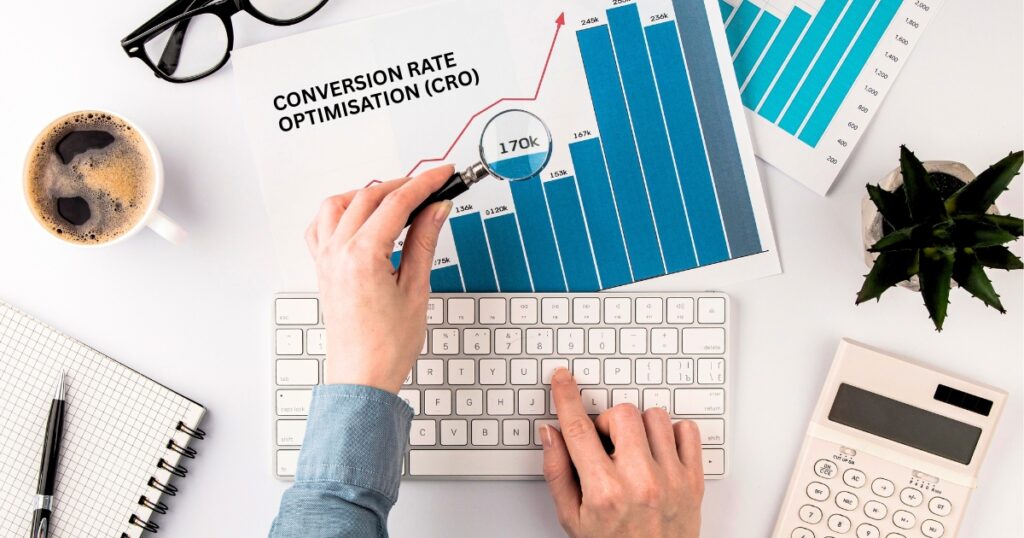
What Exactly Is Conversion Rate Optimization?
Conversion Rate Optimization is the systematic process of increasing the percentage of website visitors who complete your desired action. Could be a purchase, a demo request, a newsletter signup, downloading a whitepaper, whatever matters to your business.
Unlike traditional marketing that focuses on bringing more people to your door, CRO obsesses over what happens after they arrive. It’s about understanding human psychology, removing friction, and creating experiences so seamless that taking action feels natural. When website design and user experience align with how people actually think and behave, conversions become inevitable.
Your primary conversions (purchases, qualified leads, demo bookings) are your revenue drivers. But smart businesses also track micro-conversions: adding items to cart, engaging with interactive content, spending meaningful time on key pages. These breadcrumbs tell you who’s interested but not ready, who needs more nurturing, who’s one email away from converting.
Why 2026 Makes CRO Non-Negotiable
Customer acquisition costs have gone through the roof. Getting someone to your site now costs 2-3x what it did five years ago. Meanwhile, attention spans shrink, competition intensifies, and users expect Amazon-level experiences from every website they visit.
Consider this: 72% of website traffic now comes from mobile devices, but mobile conversion rates still lag behind desktop. Most businesses lose 32% of their mobile conversions just because their pages take longer than three seconds to load. Three seconds. That’s how thin the margin is.
The brands winning in 2026 aren’t the ones with the biggest ad budgets. They’re the ones who’ve mastered the click through rate to conversion pipeline.

The CRO Framework That Actually Works
Stage 1: The Diagnostic Deep Dive
You can’t fix what you don’t measure. Audit your current conversion funnel ruthlessly. Where are visitors landing? What’s their journey? Where do they drop off? Set specific goals like “Increase product page to cart conversion from 3.2% to 4.5% in 90 days.”
Stage 2: Behavior Research
Numbers tell you what’s happening. Qualitative research tells you why. Surveys, session recordings, user interviews uncover the psychological barriers stopping conversions. Maybe your checkout feels sketchy. Perhaps your value proposition isn’t clear. Watch real people using your site.
Stage 3: Hypothesis Formation
Form real hypotheses using this structure: “If we [specific change], then [specific metric] will [improve by X%] because [reason based on research].”
Example: “If we reduce our checkout form from 8 fields to 4, checkout completion will increase by 15% because user feedback shows people abandon due to form length.”
Stage 4: Testing
A/B testing is your validation engine. Split traffic between variations, let it run until you hit statistical significance (usually 2-4 weeks minimum), and measure everything. Don’t just track conversions, watch for secondary effects like bounce rate and session duration.
Stage 5: Analysis and Intelligence Extraction
At 95% confidence, you can be reasonably sure your results aren’t flukes. But look beyond primary metrics. A variation might boost conversions while tanking customer lifetime value. Document everything. Wins, losses, insights.
Stage 6: Implementation and Continuous Iteration
Roll out winners carefully. Then keep going. The best CRO programs never stop. They build cultures of continuous experimentation where every page, every flow, every experience is constantly evolving based on data.
The Elements That Actually Move Conversion Needles
Speed: The Conversion Killer
Sites loading in one second convert at rates 2.5 times higher than sites loading in five seconds. Every extra second of load time drops conversions by 7-10%. Compress images, enable browser caching, use content delivery networks. Make your site fast, and watch conversions climb.
Website Design That Guides
Clear value propositions, strategic placement of trust signals, obvious calls-to-action, and visual hierarchy that naturally guides eyes toward conversion points. In website design, clarity beats creativity every single time.
The CTA: Persuasion to Take Action
“Start Your Free Trial” outperforms “Submit” because it focuses on value rather than action. Test multiple CTAs throughout long pages. Someone ready to convert immediately clicks the top CTA. Others need more information first.
Forms: The Necessary Evil Done Right
Every form field you add is a hurdle. Guest checkout, autofill, progress indicators, transparent upfront costs reduce friction that causes abandonment. Cut unnecessary fields ruthlessly.
Trust Signals: The Invisible Force Multiplier
Customer reviews, security badges, clear return policies, testimonials from recognizable names address the skepticism inherent in online transactions. Place them strategically where doubt typically creeps in, and conversions often jump 3-37%.
CRO and SEO: The Power Couple
Conversion Rate Optimization and SEO aren’t competing strategies. They’re complementary forces. Page load speed affects both rankings and conversions. Mobile responsiveness impacts both search visibility and mobile conversion rates.
Optimize copy to balance keyword requirements with conversion-focused persuasion. Create blog content that attracts organic traffic while including clear conversion paths. When you nail both, you don’t just get more traffic, you get more traffic that actually converts.
Why Traffic Alone Is a Losing Strategy
Spending ₹1,00,000 to double your traffic from 10,000 to 20,000 visitors at a 2% conversion rate nets you 400 conversions. Spending ₹20,000 on CRO to improve that 2% to 4% on your existing 10,000 visitors also nets you 400 conversions.
Which approach costs 80% less and makes every future marketing rupee you spend work twice as hard?
Traffic is the beginning of the conversation, not the end. Conversion Rate Optimization is how you turn attention into action, visitors into customers, and marketing spend into revenue that actually compounds.
The Bottom Line? Conversion Wins the Game
The brands dominating 2026 are the ones who’ve mastered the entire journey from click to conversion, who understand that every visitor represents a conversion opportunity waiting to be optimized.
CRO isn’t a project with an endpoint. It’s a discipline, a mindset, a continuous commitment to making every element of your digital experience work harder, convert better, and drive more value from the traffic you’ve already earned.
So the real question isn’t whether you should prioritize Conversion Rate Optimization. It’s whether you can afford not to while your competitors are doubling their results with the same traffic you’re letting slip through your fingers.
Transform Clicks Into Customers with The Go-To Guy!
Traffic is just the opening act. Conversion is where the real money lives.
At The Go-To Guy!, we don’t just bring people to your digital door, we optimize every element of the journey to make sure they actually take action. Our approach to Conversion Rate Optimization combines behavioral psychology, data-driven testing, strategic website design, and continuous iteration to extract maximum value from every visitor.
Ready to stop bleeding money through your website and start turning visitors into customers? Let’s talk about transforming your conversion rate into a competitive advantage that actually shows up in your bank account.

