

While you read this blog post, your organic reach is prob ably slipping through your fingers.
You post, you hope, and yet fewer people seem to see your content without paid boosts, whether that’s on social media, in search results, or through email.
When we look at the numbers, organic media are still massive. For instance, by mid-2025, over 5.4 billion people worldwide were active on social media, each juggling nearly seven platforms monthly. That’s a lot of screens, notifications, and content vying for attention!
But, subtle shifts are raising questions about organic reach in 2026 across all organic marketing channels.
Despite the impressive user base, growth in already connected regions is slowing, suggesting that brands can’t rely solely on audience expansion.
The attention window is spread thin across multiple media, short-form videos, messaging, and private communities. This makes cutting through the noise more challenging, even as discovery opportunities remain significant.
Engagement behaviors are diverging. Short-form video dominates engagement, while messaging and community-focused interactions continue to rise. Emerging platforms for organic marketing are growing rapidly, emphasizing authenticity over polished content. Meanwhile, established networks still maintain large, loyal audiences.
At the same time, organic search is facing its own visibility challenges with the growth of AI searches and overviews. According to research, around 39% of marketers report a decline in traffic since Google introduced AI Overviews in May 2024. When answers appear instantly at the top of the page, regular SEO wins like “ranking #1” matter less if users never scroll far enough to see the source.
The result is a shared pressure for marketers. Organic traffic requires a much more strategic focus, high-quality content, and platform-specific tactics.
So Does This Mean Organic Reach is Dying in 2026?
Short answer? No. But the way we define organic reach has changed, and that’s where most of the confusion comes from.
Let’s rewind for a moment.
In 2024, organic reach for brand accounts was already under pressure, but it was still somewhat predictable. Large platforms hovered around a 5 to 7 percent organic reach for brand posts. Professional networks offered steadier exposure, especially for B2B brands that showed up consistently. Posting regularly, staying visible, and maintaining frequency still delivered reasonable organic traffic.
Fast forward to 2026, and the picture looks very different.
Average organic reach dropped sharply across the board. Some professional platforms saw their reach fall by more than 60 percent from earlier highs. Visual-first networks settled into the 4 to 5 percent range for most brand content. What’s changed is not user behavior alone, but how the social media algorithm, or any other media algorithms really, began ranking content.
Volume has stopped working. Passive impressions have stopped working. Feeds have started rewarding depth, interaction, and signals that suggest real human interest.
This is why organic reach feels like it vanished overnight.
For years, organic growth was judged using surface metrics. Reach percentage. Impressions. Follower count.
Now, organic performance is shaped by engagement velocity, content retention, saves, replies, and repeat interactions. These are quieter metrics, but they matter far more to how platforms distribute content.
Another reason organic reach feels weaker is saturation.
Let’s take the example of social media. Feeds are crowded. Posting frequency across brands, creators, and communities is at an all-time high. At the same time, users scroll faster and interact less with traditional formats. When engagement does not happen quickly, distribution slows almost immediately. That is the reality of how modern social media algorithms filter content.
So when you wonder if organic reach is dying, what you’re really asking is “Why does making my brand visible feel harder than it used to?”
Organic traffic today comes from relevance, not routine. It simply responds to different signals than it did even two years ago.
And once you know what the new scoreboard looks like, everything else starts to make sense.
What Is Organic Marketing Really?
Before we talk about fixing organic reach, we need to get clear on what organic marketing actually means. Because this term gets used loosely, and that’s where a lot of confusion begins.
Organic marketing refers to all marketing efforts that earn attention naturally, without paying platforms for distribution.
No boosted posts. No ad spend. No buying reach. Visibility rather comes from relevance, consistency, and how well your content aligns with platform rules and audience behavior.
Organic traffic is the result of people finding you because your content adds value, entertainment, and/or relatability to their lives.
Paid marketing works very differently. It trades money for speed. You pay platforms to place your message in front of specific audiences, instantly. That makes it useful for launches, promotions, and quick visibility. But once the budget stops, the reach stops too.
So, organic marketing compounds. Paid marketing expires.
Then there’s content marketing, which often gets mistaken for organic marketing. Content marketing focuses on creating valuable assets like blogs, videos, or newsletters. Organic marketing is about how those assets travel.
Content can live inside both organic and paid strategies. When you publish a blog optimized for search and let it attract visitors over time, that’s organic. When you promote that same blog through ads, it becomes paid distribution layered on top of content marketing.
Another key difference lies in intent.
Organic leads tend to convert better because they arrive through interest. Someone who finds you through search, social discovery, or email has already crossed a trust threshold. That’s why organic channels often deliver stronger long-term returns, even if growth feels slower upfront.
Organic marketing also spans multiple channels:
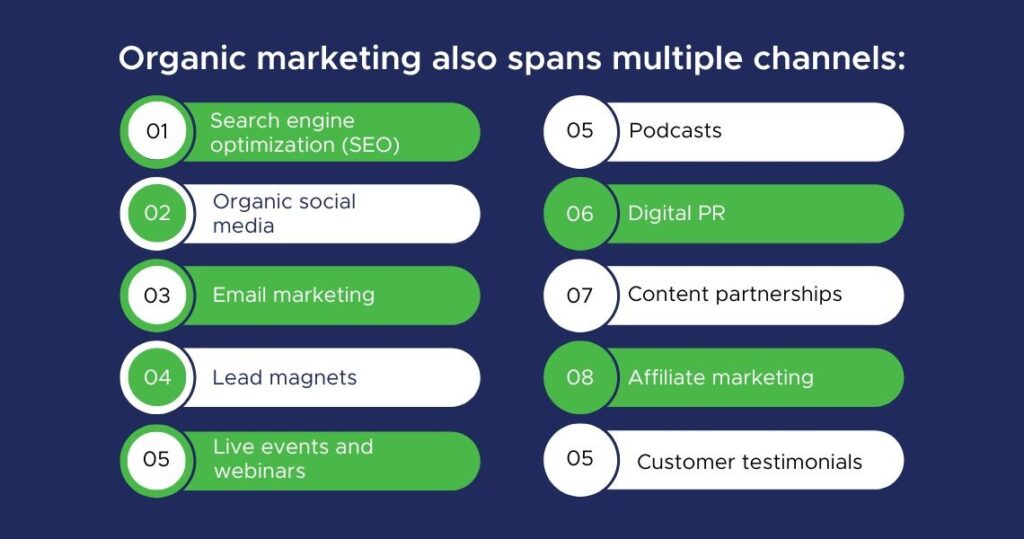
- Search engine optimization (SEO): Captures high-intent organic traffic from people actively looking for answers, products, or solutions.
- Organic social media: Earns visibility through platform-native content shaped by the social media algorithm and audience interaction.
- Email marketing: Builds direct, permission-based relationships that are not dependent on platform reach.
- Lead magnets: Convert organic visitors into subscribers by offering useful, gated value.
- Live events and webinars: Create deeper engagement through real-time education and interaction.
- Podcasts: Build trust and long-term awareness through consistent, on-demand audio content.
- Digital PR: Expands reach by tapping into existing organic audiences across publications and platforms.
- Content partnerships: Share visibility and authority by collaborating with aligned brands or creators.
- Affiliate marketing: Leverages trusted voices to drive organic recommendations at scale.
- Customer testimonials: Strengthen credibility through real experiences and social proof.
What Will Actually Work for Organic Growth in 2026?
Now comes the practical question.
If organic reach feels tighter, feeds feel crowded, and attention feels expensive, what should brands actually do next?
The answer starts with a mindset shift. Social media functions more like interest-driven media. People do not see content because they follow you. They see content because it aligns with what they care about in that moment. The social media algorithm is scanning your content for relevance every second.
This changes how brands should approach organic marketing in 2026:
Start With Fewer Channels
Trying to be everywhere rarely works anymore. Strong organic traffic comes from depth, not distribution.
Pick one primary platform where your audience spends the most time making decisions. Then choose one support platform to repurpose and reinforce ideas. This applies to both established brands and new launches. Focus creates momentum. Momentum creates visibility.
Think of it as a simple structure:
- One platform to build authority
- One platform to extend reach
- Everything else stays optional
Treat Social Media as Interest Media
Follower counts matter less than engagement density. A small audience that responds, saves, shares, and replies consistently will outperform a large audience that scrolls past.
This is where conceptual clarity matters. Repeating formats without a point of view will not earn reach. Strong ideas will. Develop signature themes, recurring perspectives, or frameworks your audience begins to associate with you. When people recognize your thinking, the algorithm follows.
Adjust Strategy Based on Brand Stage
For newer brands, organic growth is about trust-building. Personal voices matter more than polished brand posts. Founders, leaders, and employees should share experiences, lessons, and honest perspectives. People connect faster with people than logos.
For established brands, organic strength comes from structure. Clear content buckets help maintain consistency without feeling repetitive. Rotate between education, insights, behind-the-scenes moments, lessons learned, and thoughtful questions. This keeps feeds interesting and signals relevance across multiple audience needs.
Engagement is the Growth Engine
Let’s be honest. Posting without engaging is like hosting a party and leaving the room.
Daily interaction matters more than daily posting. Replies, comments, and conversations signal value to the social media algorithm. Even 15 focused minutes a day can lift meaningfully over time.
Measure What Actually Matters
Here’s the scoreboard you should be tracking now:
- Engagement rate, not follower count
- Saves and replies, not likes alone
- Organic reach trends, not single-post spikes
- Website clicks that convert into real organic traffic
These metrics show whether your organic efforts are earning attention or just filling the tight spaces on your preferred media.
Some Big No-Nos
A few clear don’ts that still hurt brands every day:
- Do not post inconsistently and expect stable reach
- Do not copy-paste the same content across platforms
- Do not ignore comments, replies, or messages
- Do not over-promote without offering value
- Do not chase vanity metrics at the cost of relevance
How Do Different Industries Benefit Most From Organic Reach?
Organic reach is far more effective in industries where decisions take time, trust is non-negotiable, and people actively research before committing. In these categories, organic traffic often influences the final choice more than any paid touchpoint.
Here’s a clear breakdown of how industry-wise organic marketing can deliver value:
| Industry Category | Why Organic Reach Works | Organic Channels That Matter Most |
| Healthcare & Wellness | Patients research symptoms, treatments, and providers before booking. Trust and clarity drive decisions | SEO, educational blogs, local search, expert-led social content |
| Legal Services | Clients seek guidance during high-stakes moments and want proof of expertise before outreach | Search-driven content, detailed guides, authority articles |
| Education & E-learning | Students and parents compare credibility, outcomes, and long-term value over time | Blogs, webinars, organic social, email nurturing |
| Financial Services | Products are complex and trust-sensitive. Buyers need explanations, not promotions | SEO, long-form content, newsletters, thought leadership |
| Real Estate | Buyers and renters rely heavily on online research and local discovery | Local SEO, listings, organic social, educational content |
| Hospitality & Travel | Booking decisions involve inspiration, reviews, and comparison | Search, visual organic social, customer reviews |
| E-commerce & Retail | Most purchase journeys start with research, even if conversion happens later | SEO, email, user-generated content |
| Fashion & Beauty | Social proof and real-world usage influence demand | Organic social media, creator collaborations, community content |
| Technology & SaaS | Buyers self-educate before engaging with sales teams | SEO, case studies, explainers, framework-led content |
How Is Organic Marketing Related to AI Search Results?
Industry research now suggests that traditional search engine usage has dropped by as much as 25%, as people increasingly turn to AI chat tools and virtual assistants for answers. That single number explains why many brands are seeing organic traffic behave differently, even when their rankings look fine.
This is where AEO and GEO start to matter.
What Do AEO and GEO Actually Change for Organic Marketing?
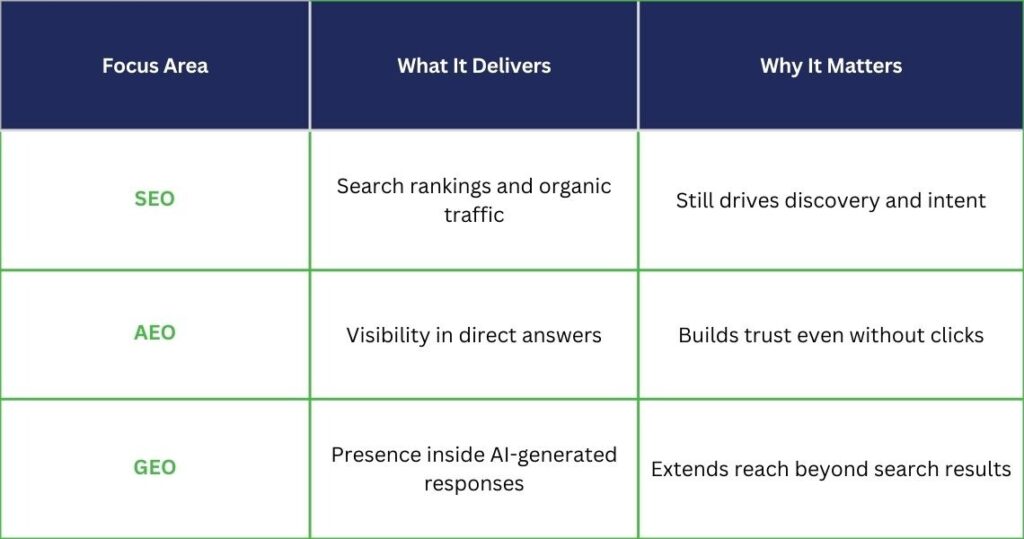
Answer Engine Optimization (AEO) focuses on making your content easy to extract and reuse as a direct answer. These are the explanations people see without clicking, inside summaries, and AI-generated responses.
Generative Engine Optimization (GEO) influences how AI tools understand your brand as a source. When someone asks a question, GEO determines whether your content shapes the response or stays invisible.
SEO still plays an important role, no doubt. Here’s how the three connect:
How Does Organic Content Power AEO and GEO?
The AI ecosystem relies on existing content to answer questions. It pulls information from blogs, guides, explainers, and educational resources that communicate clearly and consistently.
This means strong organic marketing does double duty. Content written to educate humans also becomes material that AI systems can summarize, quote, and reference. Clarity beats cleverness here.
According to data by WebFX, over 60% of Millennial and Gen Z users already use AI engines in their search routines. These engines prioritize content that shows subject knowledge, firsthand insight, and credibility. Clear author context, examples, and well-structured explanations increase the chances of your content surfacing in user searches.
Organic marketing that focuses on depth and usefulness naturally aligns with these requirements.
A few simple habits make a big difference:
- Frame sections around real questions
- Answer directly before adding detail
- Use clean structure and logical flow
- Include FAQs for related queries
These practices support organic traffic, improve visibility inside AI systems, and strengthen long-term reach.
Let’s Come Back to the Question: “Is Organic Reach Dead?”
Organic reach cannot die because marketing itself cannot function without it.
Think about how people actually make decisions.
They look things up. They read. They follow brands. They come back later. That entire journey is organic.
What does change is how that reach happens. So the question is not whether organic reach will survive. It is whether your approach keeps up.
Having the right partner matters here. Someone who understands these shifts and knows how to adapt without chasing every trend. That is how organic growth stays alive, even when the signals say otherwise.
The Go-To Guy! works with organic marketing every single day. We watch how organic traffic moves, how the social media algorithm reacts, and how discovery keeps shifting across platforms and search.
We focus on clarity, relevance, and consistency because that is what organic reach still responds to. We help brands stay visible where people are actually looking, thinking, and deciding.
To see how we can help you, start a conversation with us.
